


Keyword density remains a foundational part of on-page SEO, but its role in 2026 is more nuanced than ever. When applied strategically, it can help clarify content relevance for search engines and improve visibility on search results pages (SERPs). When misused, however, it can hinder rankings or even trigger algorithmic suppression for “spammy” practices.
In this post, we’ll unpack what keyword density means today, how to calculate it, and how to apply it effectively in an era of AI-powered search and semantic indexing.
What Is Keyword Density?
Keyword density refers to how often a target keyword appears on a webpage relative to the total number of words. It’s expressed as a percentage and helps search engines understand the topical focus of a page.
However, as of 2026, Google and other search engines like Bing and Perplexity don’t rely solely on keyword density. Instead, they use semantic relevance, user intent, and content quality signals to determine relevance. Keyword density is still useful as a diagnostic metric, but it’s no longer the primary driver of rankings.
Why Keyword Density Matter?
Keyword density plays an important role in on-page SEO because it helps search engines understand what your content is about. However, it must be used strategically.
- Helps Search Engines Identify Your Topic – When your target keyword appears naturally throughout the content, search engines can clearly determine the page’s main subject. This improves topical relevance and ranking potential.
- Prevents Keyword Stuffing – Using a keyword too often can hurt your rankings. Excessive repetition looks spammy and may trigger search engine penalties. Balanced keyword density keeps your content optimized without overdoing it.
- Improves Content Focus – Maintaining proper keyword usage ensures your content stays aligned with its main topic. This improves clarity, structure, and user experience.
- Supports Semantic SEO – While exact keyword density is less critical than it used to be, strategic placement in:
- Headings (H1, H2, H3)
- Introduction and conclusion
- Meta title and description
- URL slug
- Image alt text
helps strengthen overall SEO performance.
Keyword density still matters in 2026, but not as a target number to chase. It matters because it signals topical focus. If a primary term and its close variants appear naturally throughout a page, search engines can more confidently understand what the content is about. The goal is clarity, not repetition. Harrison Jordan, Founder and Managing Lawyer at Substance Law.
How to Calculate Keyword Density
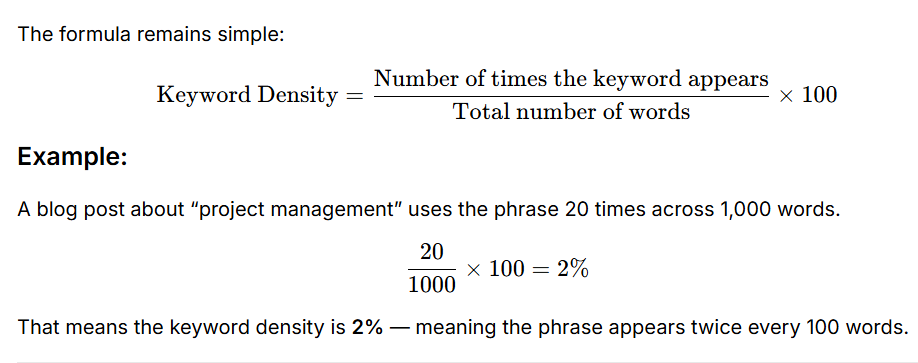
Keyword density measures how often a target keyword appears in your content compared to the total word count.
The Formula
The calculation is simple:
Keyword Density = (Number of times the keyword appears ÷ Total number of words) × 100
Example Calculation
Let’s say you’re writing a blog post about “project management.”
- The keyword “project management” appears 20 times
- The total word count of the article is 1,000 words
Now apply the formula: (20 ÷ 1,000) × 100 = 2%
What Does 2% Keyword Density Mean?
A 2% keyword density means:
- The phrase appears 2 times per 100 words
- The keyword is used naturally without excessive repetition
Is There an Ideal Keyword Density in 2026?
There’s no fixed or universally “ideal” keyword density — and Google still doesn’t provide an official guideline. Most modern SEO specialists recommend aiming for natural keyword usage, which often falls between 0.8–1.5%.
The key is contextual relevance, not repetition. Search algorithms are now powered by advanced natural language understanding (NLU) systems that detect meaning through related phrases, entities, and context rather than keyword frequency alone.
So, while keyword density can help guide optimization, what matters most is how naturally and comprehensively your content addresses user intent.
Keyword density in 2026 is no longer a fixed percentage to “hit” — it’s a byproduct of well-structured, intent-led content. Search engines now evaluate topical relevance, semantic relationships, and contextual signals rather than raw keyword frequency. Fixating on density (e.g., 1-2%) is outdated and can lead to over-optimisation patterns that suppress performance.
Instead, focus on: Clear search intent alignment, Natural primary keyword placement (title, H1, early body copy, meta description), Semantic variations and related entities, Structured formatting (subheadings, internal links, schema where relevant), Depth and completeness of topic coverage
Philip Young, CEO, Bird Digital Marketing Agency UK
Keyword Stuffing: Still a Risk in 2026
Keyword stuffing — overusing the same keyword to manipulate rankings — remains a toxic SEO practice. Google’s systems can now detect this behavior more effectively through contextual pattern recognition, readability analysis, and user engagement metrics.
Pages with unnatural repetition may not just be penalized — they’re likely to be ignored or downranked by AI-driven ranking systems. Moreover, it degrades user experience and increases bounce rates.
For the best results, focus on clarity, readability, and semantic diversity instead of keyword repetition.
Keyword stuffing remains a risk in 2026 but the bigger issue is its impact on engagement. Stuffed pages feel robotic and can cause users to bounce quickly. They tend to skim less, and the copy becomes harder to trust. Modern ranking systems also detect unnatural repetition across headings, anchors, and near-duplicate sentences. If concerned, there are three red flags to look out for.
The phrase appears repeatedly in consecutive sentences, it shows up in every header, or it’s forced into sentences that could work without it. We should replace these with intent-based phrasing that maintains the meaning. Using clear definitions, real examples, and specific qualifiers like audience, location, or use case helps ensure readable precision instead of meaningless repetition. Sahil Kakker, CEO/Founder at RankWatch.
4 Modern Strategies for Smart Keyword Use
Because keyword density is just one piece of the SEO puzzle, it’s wiser to follow today’s best content optimization practices:
1. Prioritize user intent and experience
Write for people first. Optimize afterward. Create useful, trustworthy, and well-structured content that answers user questions comprehensively. Once written, review your content to ensure the target keyword and its variations appear naturally throughout.
2. Use keyword variations and stemming
Search engines in 2026 are excellent at understanding word variations. Use keyword stemming — like turning “manage projects” into “project management” or “project manager” — to build relevance and variety.
3. Include semantic and entity-based keywords
AI-driven search relies heavily on semantic SEO. Include related terms, entities, and contextually linked concepts to strengthen topical relevance. For example, for “project management,” related terms might include workflow automation, resource planning, and team collaboration tools.
4. Audit regularly to avoid keyword stuffing
Use modern on-page SEO tools to monitor keyword balance. SEO suites like Surfer SEO, Clearscope, Ahrefs, or Semrush ContentShake AI can benchmark your content against high-ranking pages and suggest adjustments.
Modern-day strategies revolve around building topical relevance by clustering entities and associating multiple meanings with a single keyword (i.e., grouping together topics that are relevant to one another based on synonymity) versus focusing only on the total counts alone.
For example, a smart use of keywords would be to establish expertise and authority for every user’s question by addressing as many secondary and tertiary questions/answers as necessary to create a semantically rich experience for the user and for any AI-driven search engines to trust. Amit Agrawal, founder & COO at Developers.dev
How to Check Keyword Density in 2026
You can still calculate it manually with a word processor or online calculator, but most marketers today rely on AI SEO tools that perform density checks automatically.
Modern tools like:
- Surfer SEO – offers dynamic keyword density insights and TF-IDF data.
- Yoast SEO (AI version) – includes contextual keyword evaluation in real-time.
- Ahrefs Content Grader – scans for semantic completeness and over-optimization risk.
Many AI writing tools also integrate keyword density metrics directly within dashboards, making manual checks a thing of the past.
I treat density as a tool to confirm that the main idea appears where readers expect it. This includes the opening lines, headings, and key supporting sections. A good practice is to write naturally and then check the main terms in your copy. If the core phrase doesn’t appear early, the content might feel misleading; if it repeats too often, it is clear the copy is written for search engines, not customers. Vaibhav Kakkar, CEO at Digital Web Solutions
Keyword Density and AI Search (SGE)
As Google’s Search Generative Experience (SGE) continues expanding, content must be optimized not only for traditional SERPs but also for AI summaries and featured snippets. Keyword density alone won’t get you featured — but well-contextualized, clear content will.
Focus on matching intent, using natural language, and offering structured answers. These factors now outweigh pure keyword frequency in ranking algorithms.
Final Thoughts
In 2026, keyword density is best viewed as a supporting metric, not a primary ranking factor. It’s useful for maintaining balanced optimization, but true search visibility now depends on how well your content satisfies intent, demonstrates expertise, and aligns with semantic and AI-driven ranking models.
Share via: